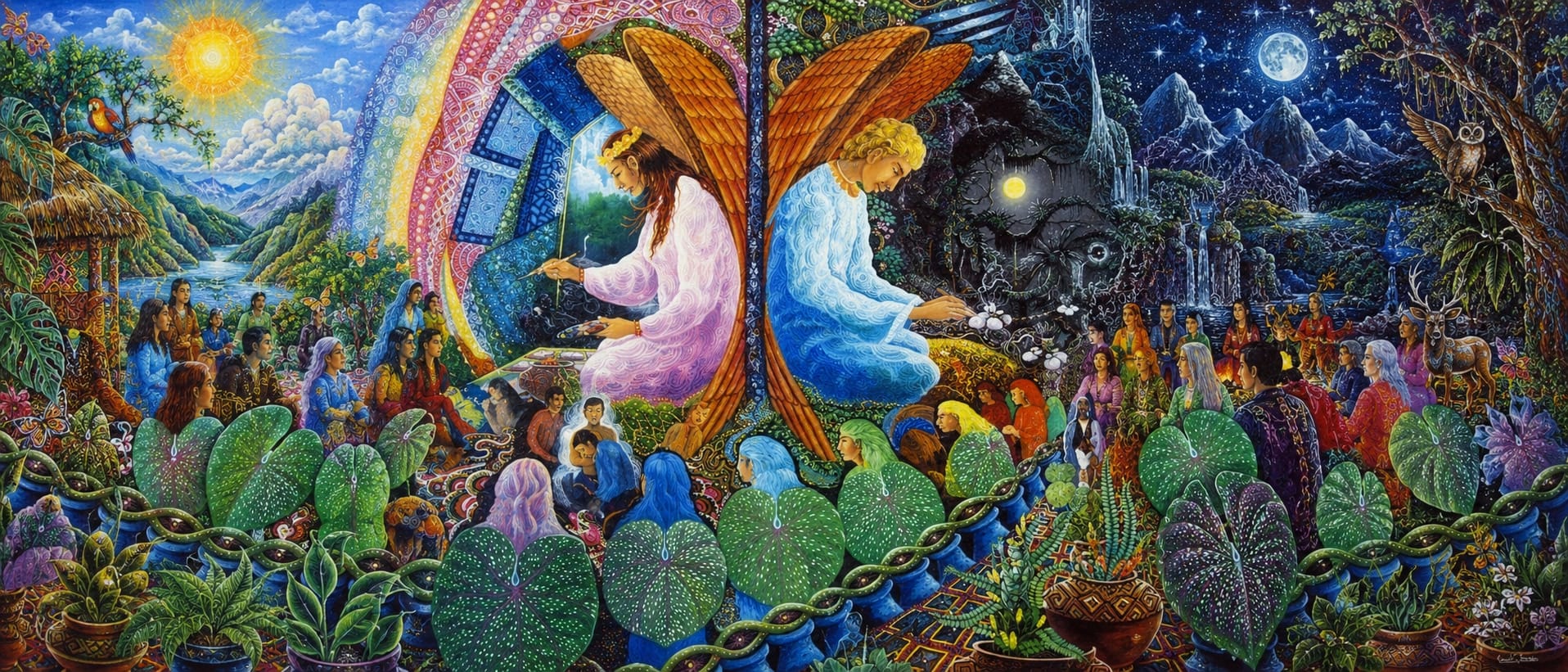
The Philosophy of the Visionary Art Workshop
The Art of Well Living
“The way we learn to paint can become the way we learn to live.”
Rooted in the philosophy of Pablo Amaringo and the Usko-Ayar Amazonian School of Painting — visionary art as truthful seeing, creative discovery, relationship, and spiritual practice.
The Source
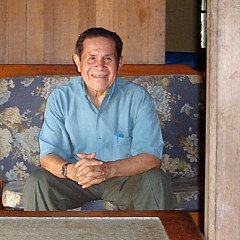
This philosophy comes from Pablo César Amaringo Shuña — David’s uncle and teacher, founder of the Usko-Ayar Amazonian School of Painting. His own paintings and the book documenting his life, The Ayahuasca Visions of Pablo Amaringo, are in the gallery’s lineage section.
Art Is Not Separate From Life
The school did not understand art merely as the production of pictures — its own historical philosophy states that its art is “not an end in itself,” that its education is “not an education for art, but for man,” and finally describes Usko-Ayar as a “School of life.”
Learning to paint well and learning to live well are not competing objectives.
The Art Is Already Within You
The teacher provides technique, discipline, materials, encouragement, and opportunities to see — but the creative capacity itself must be discovered.
Instead of searching for beauty, you participate in creating it.
Painting as a Practice of Truthfulness
The plant continually asks the artist: are you painting what is here, or your idea of what is here? That is an artistic question — and a question about life. How often do we see another person through our assumptions, or mistake fear for perception?
First learn to see what is there. Then discover what else can be seen.
Ayahuasca as a Teacher of Honesty
The medicine may ask: are you actually living what you say you believe? The canvas may ask: are you actually painting what you see? The deeper question is the same —
Are you willing to see without pretending?
Seeing the Totality
Look longer at a single leaf and it begins pointing beyond itself — to soil, water, sunlight, and the countless relationships that sustain it. This gives the workshop a movement:
attention → understanding → relationship → gratitude → responsibility
The plants support us. Do we support the plants?
The Canvas as a Doorway
A 40 × 30 canvas is not a boundary — it is a beginning. The painting gives immediate feedback: if I rush, it shows. If I refuse to look, it shows. But I can look again. I can correct. I can become quiet. I can listen. I can begin again.
Surrender and Co-Creation
Skill, discipline, and effort still matter, but they can be joined with surrender — a willingness to listen rather than insist the work obey the ego’s preconceived image. The artist learns to make themselves available to inspiration rather than treating creativity as a possession of the separate self.
Paint honestly. See accurately. Live with integrity. Receive gratefully. Give freely. Encourage beauty in others. Become still enough to listen. Let Spirit inspire the work. Participate as a co-creator. This is where visionary art becomes the Art of Well Living.
Read the complete philosophy, with full source attribution, at /docs/the-art-of-well-living.