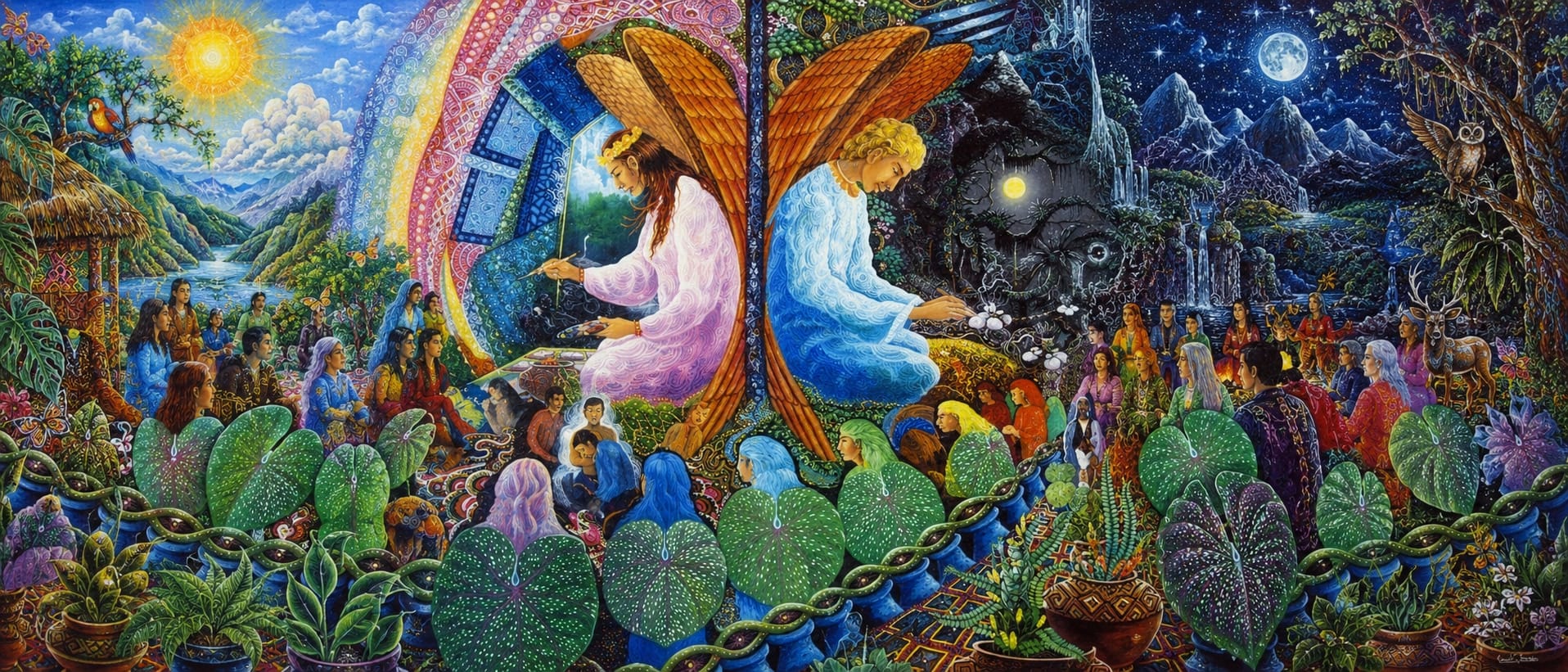
🌈 The Art of Well Living
The Philosophy of the Visionary Art Workshop
"The way we learn to paint can become the way we learn to live."
Rooted in the philosophy of Pablo Amaringo and the Usko-Ayar Amazonian School of Painting — visionary art as truthful seeing, creative discovery, relationship, and spiritual practice.
🕊️ Well Living Means Giving
The Usko-Ayar school describes its foundation as rooted in philanthropic altruism. Pablo taught altruistic love, goodness, generosity, mercy, spiritual perception, acute insight, and peace. Just as importantly, the person who learned was given both the opportunity and the obligation to teach those who came after them.
This makes Well Living more than personal development. What we receive is meant to circulate. Knowledge is given. Attention is given. Beauty is given. Encouragement is given. Skill is given. The creative gift becomes more alive when it is shared.
This is also why encouragement belongs inside the art studio. A participant does not merely learn to appreciate their own painting — they learn to receive another person's expression without comparison, to recognize beauty in innocence as well as refinement, and to strengthen the creative courage of the people beside them.
🌱 Art Is Not Separate From Life
The central idea of this workshop is deceptively simple:
The way we learn to paint can become the way we learn to live.
This principle lies at the heart of Pablo Amaringo's Usko-Ayar Amazonian School of Painting. The school did not understand art merely as the production of pictures — its own historical philosophy states that its art is "not an end in itself," that its education is "not an education for art, but for man," and finally describes Usko-Ayar as a "School of life."
Yet this does not mean artistic quality is unimportant. Quite the opposite — Usko-Ayar explicitly sought to produce both "Quality" people and "High Quality" pictorial art. The student was taught form, motif, geometry, light, shadow, color, symmetry, perspective, drawing, and technique while simultaneously being educated toward mental, emotional, physical, and spiritual balance.
Learning to paint well and learning to live well are not competing objectives.
The discipline required to create an honest, beautiful, and carefully observed work of art becomes a small laboratory in which the student can practice the same principles required for an honest, beautiful, and carefully lived life.
✨ The Art Is Already Within You
One of the most important statements in the Usko-Ayar philosophy is that education should help the student discover that art is within them — within their ability and creative imagination. The teacher provides technique, discipline, materials, examples, encouragement, and opportunities to see — but the creative capacity itself must be discovered.
Instead of searching for beauty, you participate in creating it.
The workshop therefore does not simply ask "Can I make a beautiful painting?" — it gradually introduces another question: "What does my ability to recognize and create beauty reveal about what is already within me?" This is where artistic discovery becomes self-discovery, and where art becomes something discovered individually but shared universally.
🔍 Painting as a Practice of Truthfulness
Honesty is central to the workshop. Before Usko-Ayar formally existed, Pablo was already teaching his students his "Wise Philosophies of Life" — moral principles such as honesty, respect, discipline, and loyalty, alongside spiritual principles including altruistic love, justice, goodness, generosity, mercy, spiritual perception, and peace. The qualities expected of Usko-Ayar students are equally revealing: honest, accurate, natural, clear or transparent, harmonious, and spiritual.
If you are painting a leaf — does it curve the way you assumed? Do its veins form the pattern you expected? The plant continually asks the artist:
Are you painting what is here, or are you painting your idea of what is here?
That is an artistic question. It is also a question about life — how often we see another person through our assumptions, mistake fear for perception, or tell ourselves a story because the story protects an identity we are trying to maintain.
First learn to see what is there. Then discover what else can be seen.
Correction, in this practice, is never condemnation. To see more accurately and make a change is one of the freedoms the canvas teaches — we can look again, repaint, refine, and begin again.
🌙 Ayahuasca as a Teacher of Honesty
Within this workshop, Ayahuasca is not treated primarily as a generator of spectacular imagery — it is understood as a teacher that can confront the participant with discrepancies between the life they are actually living and the person they believe themselves to be. Those experiences still require discernment and integration; they are not automatically treated as literal or infallible messages. In the philosophy of this workshop, Ayahuasca therefore serves the same fundamental movement that painting serves:
toward greater honesty.
The medicine may ask: Are you actually living what you say you believe? The canvas may ask: Are you actually painting what you see? The deeper question is the same: Are you willing to see without pretending?
🌳 Observation Is More Than Looking
Pablo Amaringo taught students not merely to copy images from books, but to paint from what they had genuinely absorbed from nature — to enter into the scene and represent it with love. Consider a single leaf: look longer and the student sees its veins, edges, irregularities, damage, color variations, reflected light, and its relationship to the branch. Look deeper still and the leaf begins pointing beyond itself — it belongs to a plant, which grows from soil, requires water, exchanges gases with the atmosphere, depends upon sunlight, and participates in relationships with insects, fungi, microorganisms, animals, and other plants.
This is seeing the totality.
Usko-Ayar explicitly connects artistic education with appreciation and preservation of creation — understanding and respecting the Amazon environment, documenting flora and fauna, preserving knowledge of medicinal plants, and spreading knowledge of Amazonian nature and culture. This gives the workshop another essential movement:
attention → understanding → relationship → gratitude → responsibility
The student does not merely ask "How do I paint this plant?" — they begin asking "What makes this plant possible? What does this living being give? What does it require? How does my own life depend upon the life around me?" And eventually: "The plants support us. Do we support the plants?"
🌌 Creation and the Giver of Life
The Usko-Ayar historical document explicitly places nature within a spiritual worldview — describing the Neo-Amazonian landscape as revealing the richness of nature and the magnificence of the Supreme Being, God, who created its sunrises, sunsets, moonlit nights, and jungle colors. Within this framework, life carries value beyond its usefulness to us — a plant is not important only because it provides oxygen, food, medicine, or beauty. It is alive. The artist begins learning to approach life not merely as a consumer, but as a participant and caretaker.
👁️ Spiritual Perception: Seeing the Whole Through the Particular
A person may spend an hour painting a single plant — yet through it they may encounter soil, water, atmosphere, sunlight, ecosystem, mortality, dependence, reciprocity, beauty, patience, God, and themselves. This is why the Usko-Ayar philosophy includes "Spiritual Perception" and "Acute Insight" among its spiritual principles.
The visionary artist learns to see worlds within what everyone else has learned to overlook.
🖼️ The Canvas as a Doorway Into the Limitless
A 40 × 30 canvas is not a boundary — it is a beginning. On the canvas, the student can practice honesty, accuracy, attention, patience, correction, humility, persistence, intuition, discernment, beauty, harmony, courage, surrender, responsibility, and love. The painting gives immediate feedback: if I rush, it shows. If I refuse to look, it shows. If I imitate because I do not trust what is genuinely within me, it shows. But I can look again. I can correct. I can become quiet. I can listen. I can begin again.
The canvas therefore becomes a starting point for a much larger practice of consciousness — not a limitation, but an opening.
🎓 Technique as a Spiritual Discipline
Because the workshop is transformational, technical excellence must not be discarded. Technique is what gives inner perception an increasingly accurate language — if you cannot yet mix the color you see, the workshop teaches you; if perspective prevents you from expressing the space you perceive, the workshop teaches perspective. This follows Usko-Ayar directly, whose curriculum deliberately taught the concrete elements of painting — form, motif, descriptive geometry, light, shadow, color, symmetry, perspective, and horizon — through progressive drawing and color processes.
Learn the craft well enough that increasingly little stands between what you truly see and what you are capable of expressing.
🌻 Visionary Art and the Authentic Self
Visionary art need not begin with visions — it begins with seeing. The visionary dimension appears when perception deepens beyond conventional appearances and the student begins recognizing relationships, meanings, symbols, and inner realities that were previously unnoticed. One person may paint something seen during Ayahuasca; another a childhood memory, a tree, a geometric structure, darkness, or simply light falling across a leaf. None is spiritually superior to another — the deeper objective is authentic expression:
What is actually here? What do I actually perceive? What am I actually feeling? What am I pretending not to know? What do I genuinely love? What wants to be expressed rather than performed?
This is the beginning of discovering the authentic self — not another personality to manufacture, not another identity to perform, but a gradual removal of what is false so that what is true can become visible.
🤲 The Shared Inner Beauty
Authentic self-discovery need not end in greater separation. The discovery that creativity lives within me can lead to the recognition that creativity also lives within others. Art is inherently shareable — a painting can begin privately inside one person's perception and then become available to an entire room. One person's inner experience can awaken recognition in another who has never lived the same life.
What is genuinely beautiful within us can be given without being lost.
This gives the workshop a movement from my art toward our shared capacity to create.
🌀 Painting the Canvas of Life: Surrender and Co-Creation
The ultimate objective is not that the participant leaves the retreat with one beautiful painting — the painting is a beginning, a visible place in which the artist can practice a relationship with inspiration that may eventually extend through the whole of life. The same principles that guide the painting can guide the larger canvas of life: observe accurately, do not pretend, correct what is false, allow what is true to remain, become still enough to listen, respect relationship, create rather than merely consume, care for what sustains life, receive inspiration gratefully, give what has been given through you.
Skill, discipline, accuracy, and effort still matter, but they can be joined with surrender — a willingness to listen rather than insist that the work obey the ego's preconceived image. Within the spiritual language of the workshop, God is the Painter and the source of the Great Inspiration; the artist learns to make themselves available to that inspiration rather than treating creativity as a possession of the separate self. Surrender is therefore not passivity — the artist still observes, chooses, practices, corrects, and gives their full attention, but these human capacities become a willing participation in something greater.
🌤️ The Art of Well Living
Pablo was not simply training painters. Before the formal school existed, he was teaching young people painting alongside philosophies and values for "Well Living." The school sought personal spirituality while remaining pluralistic and unaffiliated with any single religious or political creed — its philosophy joins artistic technique, creative development, personal formation, cultural identity, ecological responsibility, and spiritual perception.
The Visionary Art Workshop is therefore not simply an art class after Ayahuasca, nor merely a way of illustrating psychedelic visions. It is a disciplined contemplative practice through which a person learns to see more accurately, create more honestly, recognize the beauty already within, understand their relationship with the living world, surrender the need to force, and begin practicing on the canvas the principles by which an entire life might be co-created.
Accuracy keeps perception honest. Nature teaches relationship. Giving reveals Well Living. Surrender opens the way to inspiration. Spirit gives life. And the artist learns to participate as a co-creator.
That is the Art of Well Living.
🕯️ A Retreat Workshop in Practice
The practical workshop remains flexible — not built around a rigid clock, but around a recurring rhythm: a spiritual principle is introduced, the group becomes present, technique is taught, participants paint, and the experience is reflected upon and shared. The main art workshop is typically placed on the morning of an Ayahuasca ceremony day, with the day after better protected for rest and integration. In a two-week retreat there may be about six substantial classes; in a shorter retreat, four or five can carry the same essential progression.
Each class can place one guiding theme at its center — Honesty, Accuracy, Integrity, Spiritual Perception, and Giving & Well Living, culminating in Peace, Surrender, and Co-Creation — while the remaining principles stay present in the background.
Practical facilitation principles: no ranking of human worth through artistic skill (technique can differ greatly; dignity does not); real artistic instruction matters — the goal includes helping participants produce work they are genuinely proud to have created; sharing is invited, never compelled; the facilitator does not impose interpretations of visions, symbols, or emotions; encouragement is part of the curriculum; silence is used as a support for presence, not a rigid rule; nature is approached as living relationship rather than decorative subject matter; accuracy is practiced without shame — looking again and correcting are forms of freedom.
🎯 The Practical Aim
The retreat workshop succeeds when a participant can leave with more than an image. They should have experienced what it means to become present, pick up the brush despite resistance, learn real technique, see more accurately, discover beauty within, receive another person's art without judgment, encourage someone else, give what they have received, and begin to recognize the difference between forcing creation and surrendering into inspired co-creation.
Paint honestly. See accurately. Live with integrity. Receive gratefully. Give freely. Encourage beauty in others. Become still enough to listen. Let Spirit inspire the work. Participate as a co-creator. This is where visionary art becomes the Art of Well Living.
📚 Source Foundation
Primary source: "Biographic Historical Review of the 'Usko-Ayar' Amazonian School of Painting," by Juan Vásquez Amaringo. The philosophy above is rooted in the school's stated moral and spiritual principles, mission, goals, educational methods, environmental commitments, and description of Usko-Ayar as a "School of life."
Interpretive framework: Sections concerning external searching, authentic self-discovery, the canvas as a doorway into the limitless, the world as related to the activity of mind, God as Painter, surrender, and Divine co-creation are broader spiritual synthesis rather than direct quotations from the Usko-Ayar document. The document remains source-faithful when describing Pablo Amaringo and Usko-Ayar directly. In workshop language, Integrity is used as the clearest practical term for truthful alignment; the original Usko-Ayar source uses the word Justice among its listed spiritual principles.
This page is a condensed rendering of "The Art of Well Living" — the full source document is available in docs/the-art-of-well-living.md alongside this site's repository.
View the raw markdown on GitHub ↗